5 Ways Chinese Companies Hide Their Real Legal Identity
7/28/2026

Why a supplier's public name may not tell the full story
When you work with a Chinese supplier, the name you see first is often not the full legal story.
You may see an English company name on Alibaba, Global Sources, Made-in-China, a website, a quotation, a proforma invoice, or an email signature. The supplier may also provide a Unified Social Credit Code, usually called a USCC, when you ask for company registration details.
At first glance, that may feel enough.
But in China company verification, the real legal identity usually depends on the registered Chinese company name, the USCC, registration status, business scope, company type, and other public company records. An English name can be useful, but it is not always the official legal name. A USCC can be useful, but only if it belongs to the same company you are actually dealing with.
This is where buyers can run into problems.
Some suppliers use inconsistent, incomplete, or misleading identity information. In some cases, this may be a simple translation issue. In other cases, it can be a warning sign that deserves closer due diligence before you send money, sign a contract, or rely on the supplier's claims.
Below are five common ways a Chinese company may hide, blur, or misrepresent its real legal identity.
1. Providing a fake USCC that cannot be found
The USCC is one of the most important identifiers for a Chinese company. It is an 18-character code assigned to registered entities in China.
When a supplier gives you a USCC, it should point to a real registered company. If the code cannot be found in public company records, that is a serious red flag.
A missing result does not always prove misconduct. The buyer may have copied the code incorrectly, or the supplier may have made a typo. But if the supplier cannot correct the code or explain the mismatch clearly, you should pause.
A fake or invalid USCC can create several practical risks:
- You may not know who you are really paying.
- The contract may not match a real registered entity.
- You may have trouble pursuing a claim if something goes wrong.
- The supplier may be using a business identity that cannot be verified.
Before placing an order, buyers should verify whether the USCC matches a real Chinese company and whether the company name, location, and business profile align with the supplier's claims.
2. Using another company's USCC
A more subtle issue happens when the USCC is real, but it belongs to another company.
This can be harder to spot because the code may return a valid registration record. The buyer may think the supplier is verified simply because the USCC exists. But the key question is not only whether the USCC is valid. The key question is whether it belongs to the company you are actually dealing with.
For example, a supplier may show you a USCC for a registered manufacturing company, but your emails, invoices, payment instructions, or contract documents may come from a different business. The names may look similar, or the English names may be close enough to cause confusion.
This kind of identity mismatch matters because the legal party behind the transaction may not be the party you think it is.
When checking a Chinese supplier, compare:
- The USCC
- The registered Chinese company name
- The English name used in sales materials
- The company name on the proforma invoice
- The bank account holder
- The contract party
- The website and marketplace profile
- The address and contact details
If these details do not align, ask for clarification before moving forward. A legitimate supplier should usually be able to explain its legal entity, export company, factory relationship, or group-company structure clearly.
3. Creating an English name that has no clear link to the Chinese legal name
Many Chinese companies use English names for international trade. That is normal.
The issue is that English names are often not official legal names in the same way the Chinese registered name is. A company may choose a marketing-friendly English name, a shortened name, a brand name, or a completely custom name for overseas buyers.
Sometimes this is harmless. But it can also make it difficult for buyers to verify Chinese company information.
For example, an overseas buyer may receive a quotation from "Sunrise Global Manufacturing Co., Ltd." But the actual registered Chinese company name may translate to something very different, with no obvious connection to "Sunrise," "Global," or "Manufacturing."
That does not automatically mean the supplier is unreliable. However, it does mean the buyer should not rely on the English name alone.
A disconnected English name can hide the real legal entity in several ways:
- The buyer cannot easily search for the company in Chinese records.
- The supplier can use a more impressive name than its registered profile suggests.
- The company may appear larger, more specialized, or more international than it is.
- The buyer may struggle to connect contracts, invoices, websites, and registration records.
When you verify a Chinese company, always ask for the registered Chinese name and USCC. If the supplier only provides an English name, the verification process is incomplete.
4. Frequently changing English names
Another warning sign is frequent use of different English names.
A supplier may appear under one English name on a B2B platform, another name on its website, another name in email signatures, and another name on invoices or catalogs. Sometimes these differences come from translation choices or brand names. But frequent changes can also make the company harder to search, compare, and verify.
This matters because many overseas buyers search in English first. If a company changes or rotates English names, negative reviews, old disputes, abandoned websites, or inconsistent business histories may become harder to connect.
For example, a supplier might use:
- One English name for marketplace listings
- A different English name for export documents
- A different brand-style name on its website
- A different company name on payment documents
Each name may look legitimate in isolation. The risk appears when the buyer tries to connect the full picture and finds that the identity trail is unclear.
A name change is not automatically suspicious. Companies rebrand, launch new product lines, and adjust English names for export markets. But if a supplier cannot explain which legal entity is behind each name, or why different names appear across documents, that is worth checking more closely.
For supplier due diligence, consistency matters. The more important the order, the more important it is to confirm the legal entity behind every document.
5. Using English names to change the perceived company type
One of the most common sourcing questions is simple: am I dealing with a factory or a trading company?
This question matters because buyers often want to understand pricing, production control, customization ability, quality responsibility, and supply-chain transparency.
Some suppliers use English names or marketing language to shape how buyers perceive them. A trading company may present itself with words such as "factory," "manufacturing," "industrial," or "production base." A small intermediary may use an English name that sounds like a large manufacturer. In other cases, a company may highlight a factory relationship without making the legal relationship clear.
Again, this is not always misconduct. Trading companies can be legitimate and valuable. Many buyers use them successfully because they can coordinate suppliers, handle export processes, manage communication, and support smaller orders.
The problem is misrepresentation.
If a buyer believes they are signing directly with the original factory, but the legal entity is actually a trading company or intermediary, the buyer may misunderstand:
- Who controls production
- Who owns the quality responsibility
- Who can solve defects or delays
- Who receives the payment
- Who is legally bound by the contract
- Whether the supplier's business scope matches its claims
This is why company verification should not stop at the English name. Buyers should check the registered Chinese company name, business scope, registration profile, operating history, and any available public company signals.
A company that calls itself a manufacturer in English should still be reviewed against its registered profile and supporting evidence.
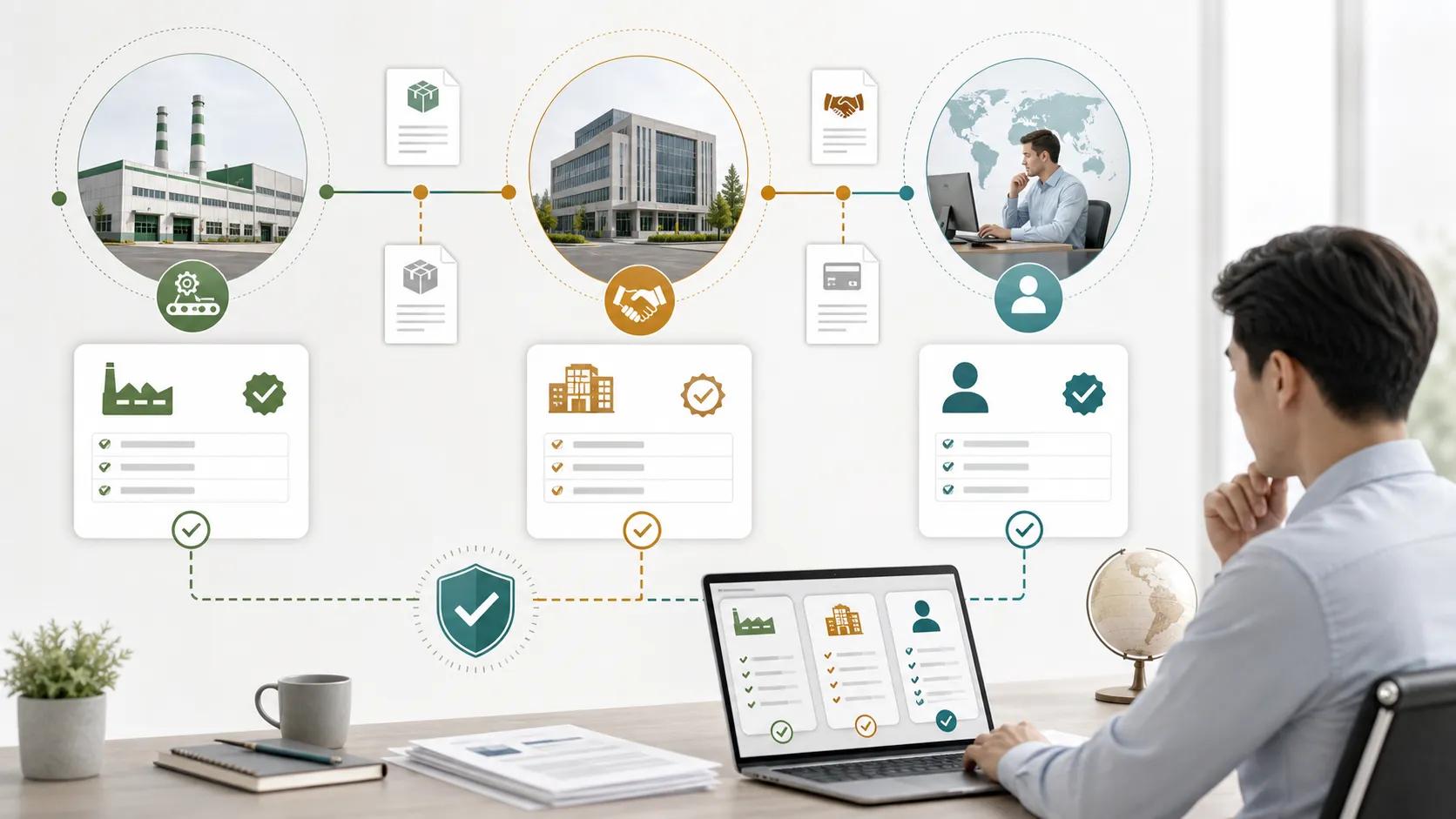
Why these identity mismatches matter
Supplier identity issues are not just paperwork problems.
They can affect contracts, payments, customs documents, quality claims, refunds, and legal accountability. If the company you pay is not the company you verified, your risk review may be based on the wrong entity.
This can become especially serious when:
- The order value is high.
- You are paying a large deposit.
- The supplier is new to you.
- You have not visited the site.
- The supplier pushes for fast payment.
- The company name on the bank account differs from the sales name.
- The supplier avoids giving its Chinese registered name.
In China supplier due diligence, the goal is not to assume every mismatch means danger. The goal is to identify mismatches early, ask better questions, and decide whether the explanation is reasonable.
How to verify a Chinese company more carefully
To verify Chinese company identity, start with the basics.
Ask the supplier for:
- Registered Chinese company name
- USCC
- Registered address
- Business license
- Company name used on the contract
- Bank account holder name
- Export entity name, if different
- Factory name and relationship, if they claim to manufacture directly
Then compare the information across documents. Do not review each document separately. Look for consistency.
Important checks include:
- Does the USCC return the same Chinese company name?
- Does the Chinese company name match the business license?
- Does the contract party match the entity you verified?
- Does the payment account belong to the same company?
- Does the English name have a clear relationship to the Chinese name?
- Does the company's registered profile support its claimed role?
- Are there abnormal-operation signals, legal-case clues, or other public risk indicators worth reviewing?
Tools like ChinVerify can help buyers review public company signals faster, especially when they need to connect English names, Chinese legal names, USCC information, and company-risk indicators in a practical first-pass check.
ChinVerify should not replace contracts, samples, inspections, references, site visits, or professional advice. But it can help buyers avoid a common mistake: verifying the wrong company.
What to do if something does not match
If you find an identity mismatch, do not rush to accuse the supplier. Ask direct, practical questions.
For example:
- "Which Chinese legal entity will sign the contract?"
- "Which company owns this USCC?"
- "Why is the invoice name different from the company name on your website?"
- "Is this entity a factory, trading company, export agent, or group affiliate?"
- "Can you provide the registered Chinese name that matches the business license?"
- "Will the payment account holder match the contract party?"
A credible supplier should be able to answer clearly. If the explanation becomes vague, defensive, or inconsistent, that may indicate the need for deeper due diligence.
For higher-value orders, buyers may also consider third-party inspections, document review, trade references, video calls, factory visits, or local professional support.
Final takeaway
To verify a Chinese company, do not rely only on the English name, website, or sales materials.
The real question is whether the supplier's public-facing identity connects clearly to a registered Chinese legal entity. A valid USCC, a matching Chinese company name, consistent documents, and a reasonable explanation of the company's role all matter.
The five red flags are worth remembering:
- A USCC that cannot be found
- A real USCC that belongs to another company
- An English name with no clear link to the Chinese legal name
- Frequent use of different English names
- English naming that changes how the company's role appears
None of these signals automatically proves wrongdoing. But each one deserves attention before you pay, sign, or scale the relationship.
If you are screening suppliers, ChinVerify can help you review Chinese company identity signals more efficiently and reduce the chance of checking the wrong legal entity.
Keep moving from research to a real verification decision
Use these next steps to compare related articles, open the right scenario, and continue into the company checks your team needs next.
Related supplier check workflows
Start checking Chinese companies now
Run a company search in seconds and review official registration data and public risk signals before you commit to a supplier.