Penetrating the Digital Showroom to Accurately Verify the Real Chinese Company and Legal Entity
6/5/2026
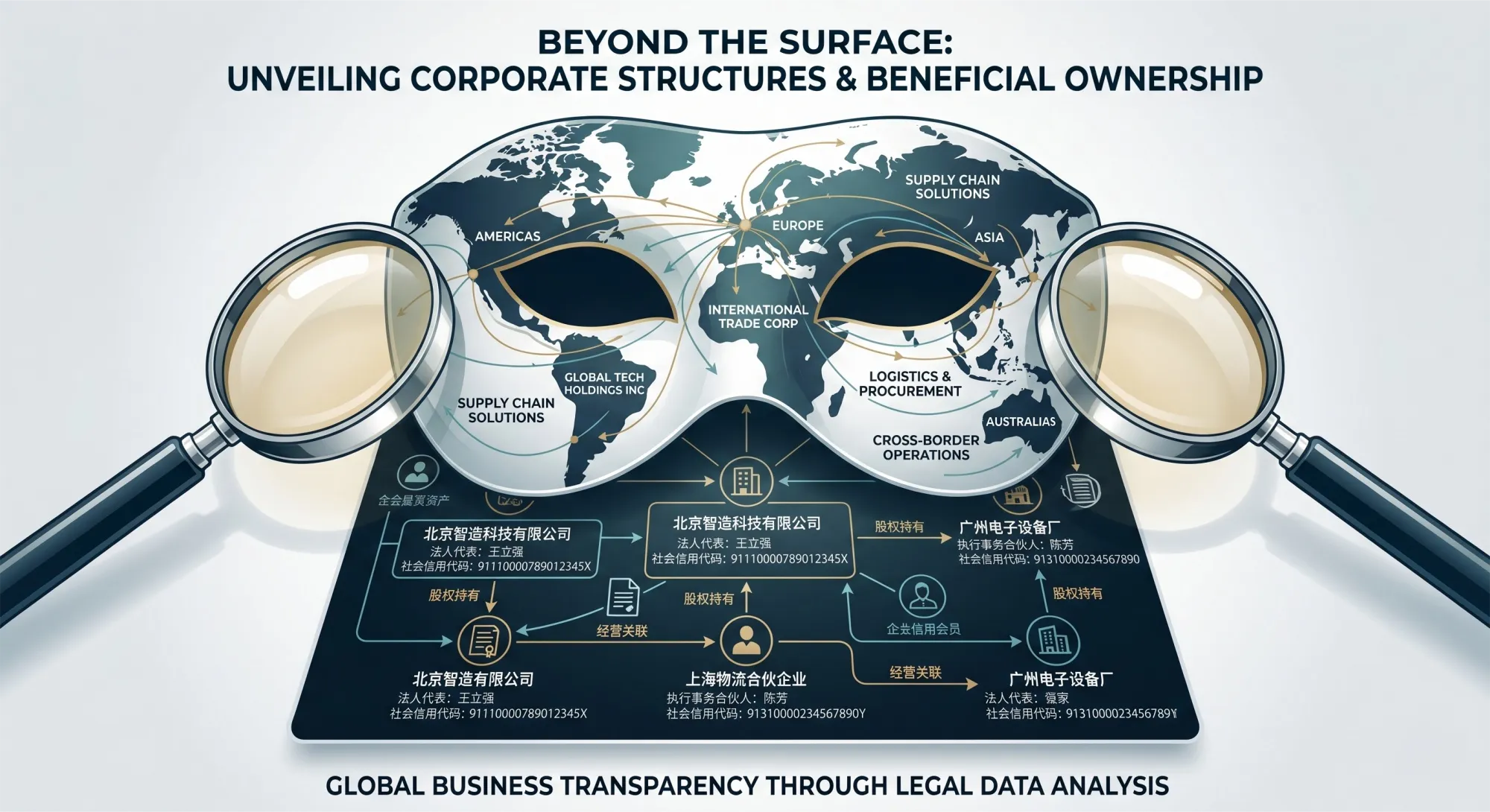
Introduction: The Digital Fog and the True Foundation of Transnational Transactions
In today's highly developed era of globalized B2B digital trade, the friction of initial discovery and connection in international procurement has been reduced to an all-time low. When an overseas buyer logs onto a sourcing platform to find potential partners, what they see is often a highly professional and visually stunning digital showroom. These suppliers typically sport highly internationalized, grand-sounding English corporate names (often packed with words like "Global," "Tech," or "Precision Manufacturing") and prominently display various verification badges issued by the platform or third-party auditors, such as "Gold Supplier" or "Verified Supplier." Accompanying these badges are meticulously shot and edited high-definition aerial drone videos of factories, close-ups of pristine and modern assembly lines, and sales representatives who respond in flawless, rapid English. For many overseas procurement teams accustomed to digital-first workflows, these front-end visual elements, marketing pitches, and platform-backed badges easily weave an initial blanket of commercial trust. This digital filter, built from exquisite web UI and seamless communication, breeds an unconscious sense of security. It makes the buyer feel as though the entity on the other side of the screen is just as reliable, transparent, and regulated as the local businesses they work with at home. However, this superficial trust often obscures the deepest and most fatal blind spot in international trade.
The real risk exposure typically materializes at the decisive moment when commercial negotiations conclude and the buyer is asked to review the Proforma Invoice (PI) and arrange an international telegraphic transfer (T/T). This is the exact moment where marketing illusions must recede and underlying legal realities must surface. Buyers must soberly realize that they are about to wire hundreds of thousands, or perhaps millions, of dollars to a bank account thousands of miles away. The legally binding procurement contract they are signing is absolutely not bound to that fancy English trademark on the webpage, nor is it bound to the enthusiastic sales representative named "Kevin" or "Linda." In the vast majority of cases, the English name displayed on the platform is merely an unregistered marketing signpost translated or invented by the Chinese company to conduct foreign trade. It likely does not exist in the official corporate registry system of the People's Republic of China, and it possesses no independent legal standing. What truly determines the risk floor of your transaction—and determines whether you can legally recover losses in the event of product defects or shipping delays—is the actual Chinese legal entity behind those English trade names and verification badges. If we cannot pierce this digital fog to lock down the exact official Chinese name of the supplier and its corresponding Unified Social Credit Code (USCC), we cannot even confirm if we are dealing with a real, legally active Chinese company. Under such asymmetric information conditions, sending wire transfers is nothing short of a high-stakes gamble. Therefore, performing deep background checks and rigorous supplier verification is the non-negotiable baseline of professional procurement.
Before diving into the specifics of how to verify a Chinese company, we must strictly define the boundaries of this guide. This is a professional manual focused on legal entity identification and basic corporate profiling; it is not an all-encompassing sourcing troubleshooting handbook. We want to state explicitly: this guide does not address how to verify physical product quality through sample testing, nor does it cover evaluating a factory's logistics fulfillment efficiency or shipping schedule controls. Similarly, it does not assess intellectual property (IP) legality, judge the technical value of ISO quality management certifications, or inspect site-specific physical compliance such as land-use permits or environmental approvals. Instead, we direct all our attention and professional expertise to one paramount, foundational, and frequently overlooked pain point: At the exact moment of executing a commercial contract, how do you utilize China's official, underlying data networks to verify the legal identity of your business partner? We will guide you in building an analytical framework based on objective, verified corporate registration data, ensuring your global supply chain is built upon a rock-solid legal entity rather than virtual webpage pixels.
What Alibaba Supplier Verification Can and Cannot Solve
Before exploring deep legal entity verification, we must first objectively evaluate the immense value of existing platform verification systems. Undoubtedly, major digital trade platforms like Alibaba invest massive resources into sanitizing the B2B trading environment. For many emerging or mid-sized global buyers, Alibaba's official safety guidelines outline multi-tier supplier verification mechanisms that serve as an easily accessible first line of defense. These include the basic A&V Check (Authentication & Verification) executed by third-party verification agencies, Onsite Checks conducted jointly by platform personnel and third-party institutions, and Verified Supplier assessments performed by world-class independent auditing giants like Bureau Veritas or TÜV Rheinland. The primary goal of these audits is to confirm that the seller is a legally registered company at the specific point in time they joined the platform or underwent their annual audit. Auditors review original business licenses, physical office locations, declared business types, and basic contact details. In the vast digital ocean, this preliminary filtering successfully filters out outright phantom accounts and unlicensed shell operations. Spotting a "Verified" badge means a professional third-party institution has, at some point, validated that entity's physical and legal existence. This is a solid starting point for any Chinese supplier background check.
However, any commercial safety mechanism has inherent boundaries. As procurement order values scale and supply chain dependencies deepen, simply knowing "this company exists" becomes insufficient. Platform documentation frankly points out these limits: the platform does not guarantee the absolute authenticity of specific goods, nor does it assume liability for the commercial fulfillment behavior or product quality of sellers. This introduces a critical cognitive upgrade for professional buyers: platform verification provides a "static snapshot of credentials," whereas a secure transnational transaction requires a "dynamic historical panorama." When a third-party auditor completes an Onsite Check on a specific date, that report is frozen in time. But the commercial landscape is highly volatile. A supplier that passed the most rigorous audit last year might today be cutting its registered capital due to cash flow crises, facing freezing orders over multiple domestic contract disputes, or getting blacklisted on the List of Abnormal Business Operations by Chinese market regulators for failing to file its annual reports. These dynamic, deep-seated, structural changes—which directly impact an enterprise's survival and fulfillment capabilities—rarely reflect in real-time on front-end digital badges. If a buyer relies solely on badges to place orders, they are essentially handing over capital based on a historical photograph. To truly control risk, buyers must step outside the platform framework and conduct independent, deep corporate due diligence.
To illustrate the difference between a static snapshot and a dynamic historical panorama, we can contrast standard platform showcases with the deep verification dimensions available through China's official national registries:
| Deep Verification Dimension | Strategic Business Value of Basic Corporate Profiling | Common Blind Spots in Standard Front-End Displays |
|---|---|---|
| Historical Names & Evolution Track | Reveals whether a company has frequently changed its official Chinese legal name to bury past contract breaches, lawsuits, or damaged market reputations. Tracing historical names is key to uncovering their complete business lifecycle. | Front-end profiles typically show only the current approved English-Chinese name combination, rarely allowing buyers to trace name-change logs over a five- or ten-year horizon. |
| Registered & Paid-in Capital | Subscribed capital is merely a promise; paid-in (actual deposited) capital represents the company's real financial cushion and risk-bearing capacity. In major damage claims, paid-in capital often sets the practical legal liability limit. | Displays might showcase a massive registered capital figure (e.g., 50 million RMB) but fail to show actual paid-in progress, shareholder contribution deadlines, or recent capital reductions designed to shield assets. |
| Official Business Scope | The officially approved business scope uses precise legal terminology to define an enterprise's operations. This is the ultimate tool to distinguish a "pure trader" from a genuine "production, manufacturing, and processing" factory. | English translations or marketing copy on storefronts often inflate and generalize capabilities, glossing over official restrictive clauses to package a pure trading agency as a manufacturer. |
| Operational Abnormalities & Litigation | Dynamically reflects a supplier's compliance threshold and commercial ethics. Frequent placement on abnormal lists (e.g., "unable to contact at registered address") or a history of quality disputes are high-risk red flags. | Since these registry data points and court cases update in real-time, static audit reports cannot capture them dynamically, and platforms rarely broadcast these red flags on front-end storefronts. |
These comparisons yield a profound conclusion: the English names and badges on the front end are merely a supplier's business attire; the Unified Social Credit Code (USCC) recorded by the State Administration for Market Regulation (SAMR) is the actual skeleton that runs through the company's entire lifecycle. Using this unique, unalterable code as an anchor, we can untangle the company's shareholder network and identify its actual controlling individuals. Frequently, a small, newly established trading company on the surface belongs to a complex web of parent-subsidiary relationships, or its actual owner controls other debt-ridden, blacklisted enterprises. By remaining on the surface of basic badges, buyers remain blind to these systemic risks. We strongly advise professional buyers to integrate the verification of the Unified Social Credit Code into their standard operating procedures (SOP) for every major transaction.
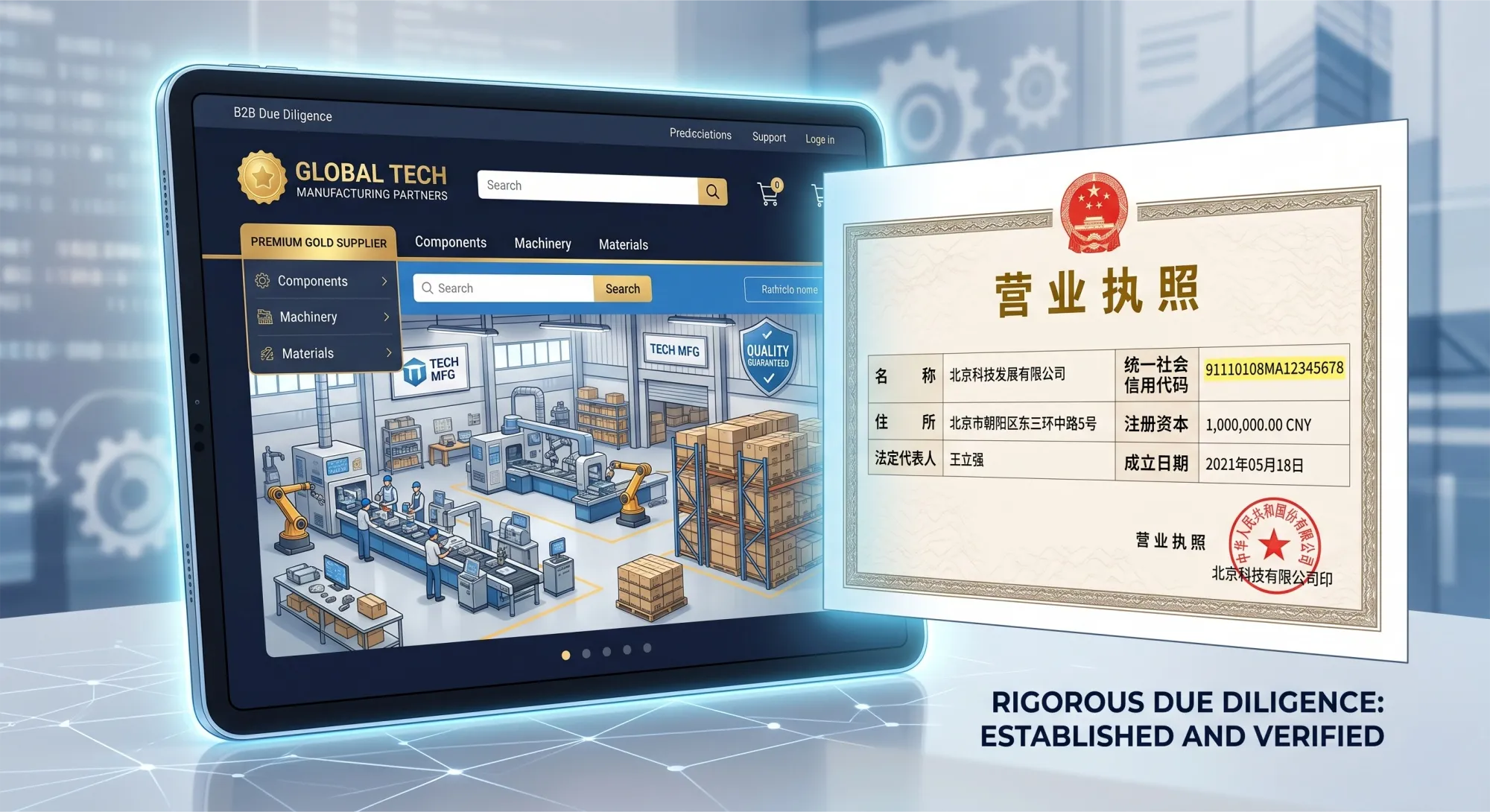
Penetrating the Facade: Seven Warning Signals of Entity Disguise and Identity Obfuscation
Having established the importance of underlying registry records over front-end displays, we must now apply this theory to the complex, highly strategic playground of real-world sourcing. Within the massive and vibrant ecosystem of Chinese B2B suppliers, the vast majority of enterprises are highly ethical, relying on quality products and efficient services to win global business. However, in the highly asymmetric context of international trade, a small subset of operators systematically attempts to blur their legal identities. Their motives vary: some seek more search traffic through multiple storefronts, others inflate their capabilities to command higher margins, and the most predatory do so to evade contractual liabilities or coordinate international payment scams. For overseas buyers, these maneuvers are cloaked in polite, professional, and grammatically flawless English emails or instant messages. Below, we dissect seven classic identity-masking patterns to help procurement teams catch abnormal signals early and understand why every Alibaba background check must ultimately anchor back to official Chinese registry records.
1. Bypassing Platform Verification Systems to Privately Send Forged Credentials
In the world of identity obfuscation, this is a relatively rudimentary yet surprisingly effective tactic. Some operators, knowing they cannot pass the platform's rigorous verification due to substandard qualifications or historical blacklisting, set up basic accounts or purchase low-cost, disposable storefronts. When an overseas buyer requests their business license, tax registrations, or production permits, these sellers skillfully bypass the platform's official document-sharing portal. Instead, they send beautifully designed PDF or JPEG scans via WhatsApp, WeChat, or private email. These documents often sport highly realistic official red stamps, sophisticated layouts, and even fabricated QR codes. To an overseas buyer unfamiliar with the specific formats, security patterns, and layout rules of official Chinese certificates, these high-resolution, digitally manipulated images look perfectly genuine. The danger of this method lies in how it exploits a buyer's natural respect for official-looking paperwork while cutting off the means to verify it. Attempting to spot a forgery by eye is futile. The buyer must demand the exact Chinese legal name and extract the Unified Social Credit Code. Forging digital pixels is free, but manipulating the national database is impossible. Cross-checking the extracted name and code against official state registries instantly shatters this deception, serving as the first true test of a supplier's authenticity.
2. The Shell Matrix and Store-Group Strategy Behind Similar English Names
In B2B search algorithms, exposure is everything. To monopolize search results and capture maximum traffic in specific niches, some highly strategic suppliers deploy a "store-group" or "shell matrix" approach. They register dozens of distinct storefronts using highly similar, phonetically identical, or slightly varied English names—such as "Shenzhen Precision Tech Ltd." and "Shenzhen Precision Technology Co., Ltd." When global buyers compare quotes from what they believe are three or four independent factories, they may spend weeks negotiating, comparing samples, and debating terms, completely unaware that the representatives behind all these screens are sitting in the same office, or are indeed the exact same person. The deeper danger is that these highly similar English names often correspond to entirely different Chinese legal entities. The supplier might use their strongest, fully verified company as their premium flagship store to attract major buyers, while routing smaller, riskier, or lower-margin orders to a matrix of disposable shell companies with minimal registered capital. When the buyer finally receives the Proforma Invoice (PI), they find the beneficiary bank account is tied to a Chinese company name completely different from the storefront's branding. If a major quality failure or delivery disaster occurs, the supplier can effortlessly abandon the blacklisted shell and activate another account in their matrix, leaving the buyer with no recourse. This is why deep corporate due diligence is paramount: you must verify the exact legal entity behind every specific PI, ensuring the actual signatory possesses the financial substance to cover potential defaults.
3. Chameleon Strategy: Erasing Historical Footprints Through Frequent Rebranding
Goodwill is a company's most valuable asset. However, for suppliers with a history of contract breaches, quality disasters, or exposures on international buyer blacklists, negative reputation is a massive barrier to securing new business. To bypass initial buyer screening, these companies utilize a "chameleon strategy." Because English trade names are not legally mandated, unique identifiers in China's domestic registry (meaning any company can declare any English brand name they want), changing an English brand name and redesigned logo costs almost nothing. These suppliers will completely discard their tainted English trade identities, adopt a fresh, highly modern English brand, and buy a new web domain to sever all search links to their past defaults. Standard international web searches on their new brand will return clean, empty results, leading buyers to believe they are dealing with a fresh but reputable startup. However, while internet memories can be scrubbed, Chinese registry archives are permanent. No matter how a company changes its English brand on the front end, its Unified Social Credit Code remains uniquely tied to its legal life. Even if they change their official Chinese legal name, the change must be filed with the regulator, leaving a clear, chronological paper trail of historical name changes. By tracking their unique USCC, buyers can uncover every past name. Discovering that a supplier has changed its registered Chinese name four or five times in three years is a flashing red flag, signaling severe organizational instability or an active attempt to outrun historical liabilities.
4. "Golden Cicada Shedding Its Shell" : Escaping Trust Crises by Shutting Down and Reopening
While frequent name changes hide past scars, shutting down and reopening a business is an extreme exit strategy designed to completely sever legal liability in the face of major claims or regulatory bans. In international trade, we often observe a tragic scenario: when a supplier's major manufacturing defect ruins an entire shipment, exposing them to a million-dollar claim from an overseas buyer, or when severe platform violations trigger an imminent account ban, the owners execute a cold, calculated business pivot. They abruptly cease all operations under the old account, quickly siphon off all liquid assets, and apply to local regulators to officially dissolve the Chinese legal entity. This legally extinguishes the corporate body that carried the debts and lawsuits. Almost immediately, using the names of distant relatives, junior employees, or nominees, they register a brand-new shell company in the same city—often in the exact same office building. They open a new storefront with the new legal entity, utilizing the same product images, the same supply lines, and the same sales team to target new overseas buyers. When unsuspecting buyers encounter this "new" supplier, the sales team confidently boasts "over a decade of deep manufacturing experience." This verbal claim stands in stark contrast to their actual shell status. At this stage, communication alone cannot reveal the risk; it requires strict database verification. If the corporate records show the entity was registered just three months ago with entirely unpaid subscribed capital, the claim of deep historical experience collapses. Tracing the new legal representative's history often reveals hidden ties to the dissolved entity—uncovering a classic "golden cicada" shell-shedding play.
5. Cleverly Packaged English Vocabulary and Hidden "Pure Trader" Attributes
In global sourcing, bypassing intermediaries and dealing directly with the source factory is highly coveted to secure optimal pricing and direct quality control. Consequently, overseas buyers heavily search B2B platforms with a strong intent to verify genuine Chinese factories. Trading companies, fully aware of this preference, carefully package their English brand names to look like manufacturers. They liberally stack words like "Manufacturing," "Industry," "Technology," or "Precision" in their English names to project an image of sprawling industrial compounds, heavy machinery, and hundreds of assembly-line workers. In early email exchanges, they avoid terms like "trading" or "sourcing," speaking strictly of "our production lines" and "our engineering team." Yet, all linguistic packaging dissolves when confronted with official registry files. When pressed to present their actual Chinese business license, these intermediaries hesitate or stall. A translation of their official Chinese name often reveals words like "Trading Co., Ltd." or "Import & Export Co., Ltd." . The ultimate proof lies in their official, government-approved business scope. In China, corporate activities are strictly categorized and regulated. If a supplier's official business scope only lists "sales," "wholesale," "retail," or "import and export of goods," and completely lacks terms like "production," "manufacturing," or "processing," then regardless of how grand their English brand name sounds, they are legally and physically incapable of manufacturing. Recognizing this legal reality is a vital line of defense.
6. Visual Deception: Pirated and Spliced "Grand Factory" Illusions
With the rapid evolution of digital marketing, the deceptive power of visual content has grown exponentially. On B2B platforms, highly polished visual media often overrides dry text profiles. To quickly build trust, some asset-light trading firms forge a manufacturing identity by hijacking visual assets. They download high-quality workshop photos, CNC machining clips, and drone footage from the websites or social media channels of genuine, large-scale domestic Chinese manufacturers. They edit these assets, overlaying their own English logo watermarks to present a grand, highly cohesive factory illusion in their digital showroom. A buyer viewing these files in isolation is highly susceptible to the trap. However, careful observation often reveals subtle cracks: a strange stylistic and architectural disconnect between different workshop photos, workers wearing uniforms with partially blurred logos of different companies, or a flat refusal to conduct an unscripted, real-time video walkthrough of the workshop due to "confidentiality" or "poor cellular reception inside the building." To shatter this visual illusion, database cross-referencing offers a powerful tool. If a supplier's video showcases a 10,000-square-meter dust-free manufacturing center, but their official registered address on their business license points to a tiny, shared office on the 28th floor of a downtown CBD skyscraper, this physical impossibility instantly exposes the factory claims as a fabrication.
7. Defensive Concealment: The Ghostly Showroom with Zero Footprint in the Physical World
In contrast to suppliers who use elaborate branding to inflate their scale, another class of operators adopts an extreme strategy of defensive concealment. These suppliers keep an exceptionally low profile, not to boast, but to minimize the risk of being tracked down or held legally accountable by overseas buyers in the event of default or fraud. Their digital storefronts are filled with thousands of clean, generic product renders, abstract process diagrams, and stock photos of office environments. However, you will not find a single visual asset that ties their virtual store to a specific physical location in the real world. Their pages contain no real-life photos of their building exterior with their Chinese company sign, no reception desk branding, and no group photos of their management team in front of identifiable corporate markers. They deliberately strip away all physical world anchors, making their virtual storefront a ghostly presence floating on the web. If they default on an order or ship substandard scrap, they can pull the plug on the account and vanish overnight, leaving the buyer with no physical trace to pursue. When dealing with a supplier that meticulously hides its physical footprints, returning to cold, official registry data is the buyer's only move. By retrieving their unique USCC and pulling their registered address, tax records, and annual filings, you force this digital ghost back into the physical jurisdiction of the Chinese legal and regulatory system—ensuring they are a real entity that can be located, served, and prosecuted.
Transnational Sourcing Due Diligence: The Indispensable Objective Data Checklist Before Placing Orders
Moving past the polished front-end showrooms and understanding these seven common identity-obfuscation tactics can feel overwhelming for international buyers. Sourcing in a foreign jurisdiction seems fraught with landmines. However, in B2B commerce, nearly all systemic risks can be identified and mitigated if you apply the right verification framework. Shifting your due diligence from subjective, front-end marketing claims to objective, verified, government-registered corporate data is the core of this methodology. Before you finish negotiations, pay a deposit, or sign any Proforma Invoice or contract, running a standardized corporate registration check is absolutely vital. This check is not a bureaucratic hurdle that slows down procurement; it is the single most cost-effective investment you can make to secure your capital and protect your supply chain. We have compiled the core Chinese Company Verification Checklist below. We strongly recommend verifying each point before executing any wire transfers:
- Exact Chinese Statutory Name : All supplier due diligence starts here. Never sign a contract that contains only an English name. You must firmly insist that the supplier provide their exact, officially registered Chinese legal name on the Proforma Invoice or contract. Under Chinese jurisdiction, English company names hold no statutory weight; only the official Chinese name can be used to identify the correct defendant in a legal dispute, international arbitration, or regulatory complaint.
- Unified Social Credit Code (USCC): This is the unique 18-digit alphanumeric identifier assigned to every Chinese enterprise. It is the golden key to unlocking their official records. No matter how many times a company changes its English brand, relocates its offices, or swaps its shareholders, this code remains permanently unchanged. Verifying this code in official registry systems is the most reliable way to trace their corporate history and prevent them from escaping liabilities through rebranding.
- Real-time Operating Status: Simply knowing a company was registered is not enough; you must verify that it is currently active and healthy. A legitimate trading partner must show an active status such as "In Operation" in the official registry. If the status shows "Deregistered", "Revoked" , or "In Liquidation" , immediately halt all payments. Wiring money to a legally dead entity is a near-guarantee of total capital loss.
- Exact Date of Establishment : This is a simple but powerful tool to test a supplier's marketing integrity. Compare the official registry date of establishment against the industry experience they claim on their website. If a supplier boasts twenty years of advanced CNC manufacturing experience, but their legal entity was registered a mere six months ago, you are dealing with a severe mismatch—either a fabricated history or a suspicious store-reopening play designed to shed past liabilities.
- Registered & Paid-in Capital: This indicates the legal and financial depth of your supplier. Do not look only at the registered capital (which is often a long-term promised amount); verify the actual paid-in capital . If a small micro-enterprise with only 100,000 RMB in paid-in capital is taking on a high-value, multi-million dollar custom manufacturing order, this massive leverage ratio means they have negligible financial padding to absorb production failures, leaving you highly exposed in the event of default.
- Official Business Scope : This is the most objective, unalterable indicator of what a company is legally permitted to do. Read the officially approved business scope to determine if they are a real factory. If the scope contains terms like "production" , "manufacturing" , or "processing" , they possess physical production qualifications. If it only lists "sales" , "wholesale" , or "import and export" , they are legally classified as a pure trading intermediary.
- Recent Major Change Records: Corporate changes are normal, but sudden, dramatic shifts around the time of a major contract are a critical warning sign. Look closely at whether the legal representative, majority shareholders, or registered address changed abruptly in the last six months. If the founding owner suddenly exited and transferred the company to an unrelated natural person right before you finalize a major deposit, it often signals an imminent bankruptcy or an active asset-stripping maneuver.
- Judicial Cases & Dishonesty Records : This directly reflects a company's commercial integrity and financial health. While minor disputes can occur, a pattern of extensive litigation—such as repeated sales contract disputes or product liability claims—or being officially blacklisted by Chinese courts as a "Dishonest Judgment Debtor" indicates severe risk. Their corporate bank accounts could be frozen by courts at any moment, meaning any deposit you wire could be trapped instantly.
Conclusion
In the complex landscape of global supply chain management, robust commercial trust is never built on a few polite emails or a virtual verification badge. As we have emphasized throughout this guide, front-end English names, shiny marketing graphics, and platform badges are merely the starting line of a commercial conversation. In the face of serious contractual risks, shipping delays, and financial exposures, these superficial elements offer zero protection. Mature, professional procurement decisions must rest upon cold, objective, and unalterable registry facts. Piercing through the digital fog to verify the underlying Chinese legal entity is an indispensable discipline.
However, executing these checks can be exceptionally challenging for international buyers. Translating and interpreting Chinese business filings, navigating national databases, and untangling complex local regulations present significant linguistic and administrative barriers. If you are preparing to place a major order and find it difficult to retrieve, translate, and cross-reference these official Chinese records, ChinVerify is here to help as a focused, objective tool. We specialize strictly in the extraction, translation, and systematic organization of public Chinese corporate registry and judicial records, helping international buyers bridge the language gap to access an objective profile of their business partners. We do not offer subjective ratings of a supplier's quality, nor do we guarantee their products. Our sole mission is to provide you with a transparent, data-driven report of who, legally, you are actually dealing with. Confirming the true identity of your counterparty before sending wire transfers is the ultimate bottom line of global sourcing.
Keep moving from research to a real verification decision
Use these next steps to compare related articles, open the right scenario, and continue into the company checks your team needs next.
Related supplier check workflows
Start checking Chinese companies now
Run a company search in seconds and review official registration data and public risk signals before you commit to a supplier.